Why One Resume Isn't Enough: The Power of AI Job Tailoring
Introduction: The Death of the Generic Resume
For decades, the standard job search strategy was simple: write a comprehensive resume, print out dozens of copies, and mail them to every hiring manager in town. When the internet arrived, this strategy evolved into the digital "spray-and-pray" method: uploading a single, all-purpose resume to dozens of online job boards and clicking "Apply" on as many listings as possible.
In 2026, this generic approach is officially dead. Blasting a single resume to multiple job types is no longer a viable way to find a job; it is a fast track to automated rejection. The reason is simple: recruitment systems have become highly sophisticated, and candidate volume has exploded. A generic resume that tries to please everyone ends up convincing no one—and scoring poorly on automated algorithms.
To stand out in a crowded candidate pool, you need a highly targeted application strategy. You must submit a job tailored resume that is specifically configured to match the requirements of each individual listing. In this guide, we will analyze the science behind resume relevance, outline why generic resumes fail, and show you how to leverage an AI resume builder to automate your resume optimization workflow.
The Numbers Game: Why Spray-and-Pray Applications Fail
To understand why customization is mandatory, consider the challenges modern recruiting teams face. On average, a single corporate job posting receives over 250 applications. For high-profile tech or remote positions, that number can easily soar into the thousands.
A human recruiter cannot physically read 250 resumes for every open position. If they spent just 2 minutes on each resume, it would take over 8 hours of uninterrupted reading to screen a single job posting. To handle this workload, recruiters rely on Applicant Tracking Systems to filter out the noise.
When candidates apply, the parser extracts their experience and calculates a matching percentage based on keyword occurrence and proximity. If a recruiter opens the ATS dashboard, they do not see a chronological list of applicants. Instead, they see a ranked leaderboard of candidates sorted by their matching scores.
Consider the following scenario: A company is hiring a "Content Marketing Manager." Candidate A submits a generic marketing resume listing their experience in brand building, PR, copywriting, graphic design, and social media. Candidate B submits a job tailored resume focused specifically on content strategy, SEO keyword research, editorial calendar management, and blog analytics—matching the exact terminology of the job listing.
| Feature | Candidate A (Generic Resume) | Candidate B (Tailored Resume) |
|---|---|---|
| ATS Match Score | 52% (Low relevance tier) | 87% (Top leaderboard tier) |
| Recruiter Action | Never reviewed (hidden deep in the database pages) | Reviewed within the first 10 minutes of screening |
| Outcome | Automated Rejection Email | Interview Invitation |
Both candidates might be equally competent marketers, but Candidate B understood that the system rewards specificity. By failing to customize resume for job requirements, Candidate A was rejected before a human recruiter could even evaluate their potential.
The Anatomy of a Job-Tailored Resume
Tailoring your resume does not mean fabricating experience or rewriting your entire history from scratch for every application. Rather, it is the art of highlighting the aspects of your background that are most relevant to the employer. A successful job tailored resume involves adjustments in four key areas:
1. The Professional Summary
Your professional summary is the hook of your resume. It should directly echo the language of the job listing. If the job description is seeking a "detail-oriented Project Manager with experience in managing SaaS product launches," your summary should begin with those exact terms, rather than a vague statement like "Result-driven professional seeking growth opportunities."
2. Keyword and Skill Re-ordering
Align your skills section with the requirements of the posting. If the description lists "Python" and "SQL" as mandatory requirements and "Tableau" as preferred, ensure Python and SQL are listed first in your technical stack. The order in which skills appear signals their relative importance to modern parsers.
3. Synonyms and Terminology Matching
Even if you are performing the exact task requested, using different synonyms can cost you interview invites. If a job posting requires "Cross-functional Collaboration" and your resume says "Inter-departmental teamwork," the parsing algorithm may miss the connection. Align your vocabulary to match the employer's terms exactly.
4. Contextualizing Experience Bullets
Modify your accomplishment bullets to highlight the specific outcomes the employer values. If a company is looking for someone to "reduce customer churn," review your past roles and reframe your achievements to emphasize retention and client satisfaction metrics.
The Technical Science of Relevance: How ATS Algorithms Score Resumes
To build a bulletproof application strategy, it is helpful to understand the underlying mathematics of resume optimization. Modern Applicant Tracking Systems do not just look for single keywords; they use advanced information retrieval and NLP models to assess document relevance.
One of the core mathematical principles used in search engines and parsing databases is TF-IDF (Term Frequency-Inverse Document Frequency). This algorithm evaluates how important a word is to a document relative to a collection of documents. If a job description frequently repeats a term like "Continuous Integration" or "Sales Pipeline," the TF-IDF weight of that term increases. If your resume contains that term in high frequency and close proximity to related terms, your relevance score surges.
In addition, state-of-the-art systems in 2026 employ Semantic Vector Embeddings. The system translates the entire job description and your resume into multi-dimensional coordinate vectors. By calculating the Cosine Similarity between the two vectors, the algorithm determines how closely aligned your experience is to the role.
Because semantic models understand concepts rather than just spelling, they group terms based on context. If the job description requests "AWS hosting" and your resume mentions "Cloud deployment on EC2," a vector parser will calculate a positive semantic match. However, to maximize your score across all parsing engines (including older keyword matchers), it is always best practice to align your vocabulary with the employer's exact phrases.
The Rise of Semantic Search and Machine Learning in Recruiter Dashboards
Recruiter dashboard search bars have evolved beyond simple text search. Today, recruiters write complex queries that include Boolean strings combined with experience ranges, degree requirements, and location preferences. For example, a search string might look like: ("Node.js" OR "TypeScript") AND "Microservices" AND "AWS" AND "Kubernetes".
If your resume lists general terms like "Web Development" and "Backend Engineering" but does not explicitly name the tools and architecture patterns like "Node.js" or "Microservices," the parsing script will ignore your profile for this specific search. It is not enough to be a general programmer; you must represent your skills using the precise nouns and terminology the company uses to search their applicant pool.
This is why customize resume for job descriptions is so powerful. By aligning your structural keywords to the recruiter's search syntax, you ensure your name pops up on the first page of their database search results, rather than being buried under thousands of unindexed profiles.
The Manual Tailoring Bottleneck
While the benefits of submitting a customized resume are clear, the process of doing so manually represents a major bottleneck for job seekers.
A thorough manual tailoring workflow requires you to:
- Print out or open the job description in a split screen.
- Carefully read through the description, highlighting skills, tools, and methodologies.
- Compare the highlighted list against your current resume to find gaps.
- Manually re-word your professional summary to align with the role.
- Edit individual experience bullet points to integrate missing keywords.
- Export the customized file as a PDF, naming it appropriately (e.g., "Jane_Doe_Marketing_Manager_Company.pdf").
This process takes anywhere from 45 to 90 minutes per job application. If you are applying to 20 jobs a week, manual resume optimization consumes nearly 30 hours of work. Job seekers quickly burn out, get overwhelmed, and revert to sending generic resumes, which leads to immediate rejection and a frustrating job hunt.
In a competitive market, you cannot afford to waste hours on formatting adjustments. You need a way to combine the high response rate of a customized application with the speed of a bulk strategy.
Enter AI Resume Rewrite: The Next Frontier in Career Search
Fortunately, the rise of artificial intelligence has revolutionized the job application workflow. By leveraging natural language processing (NLP) and large language models (LLMs), modern career platforms can automate resume optimization.
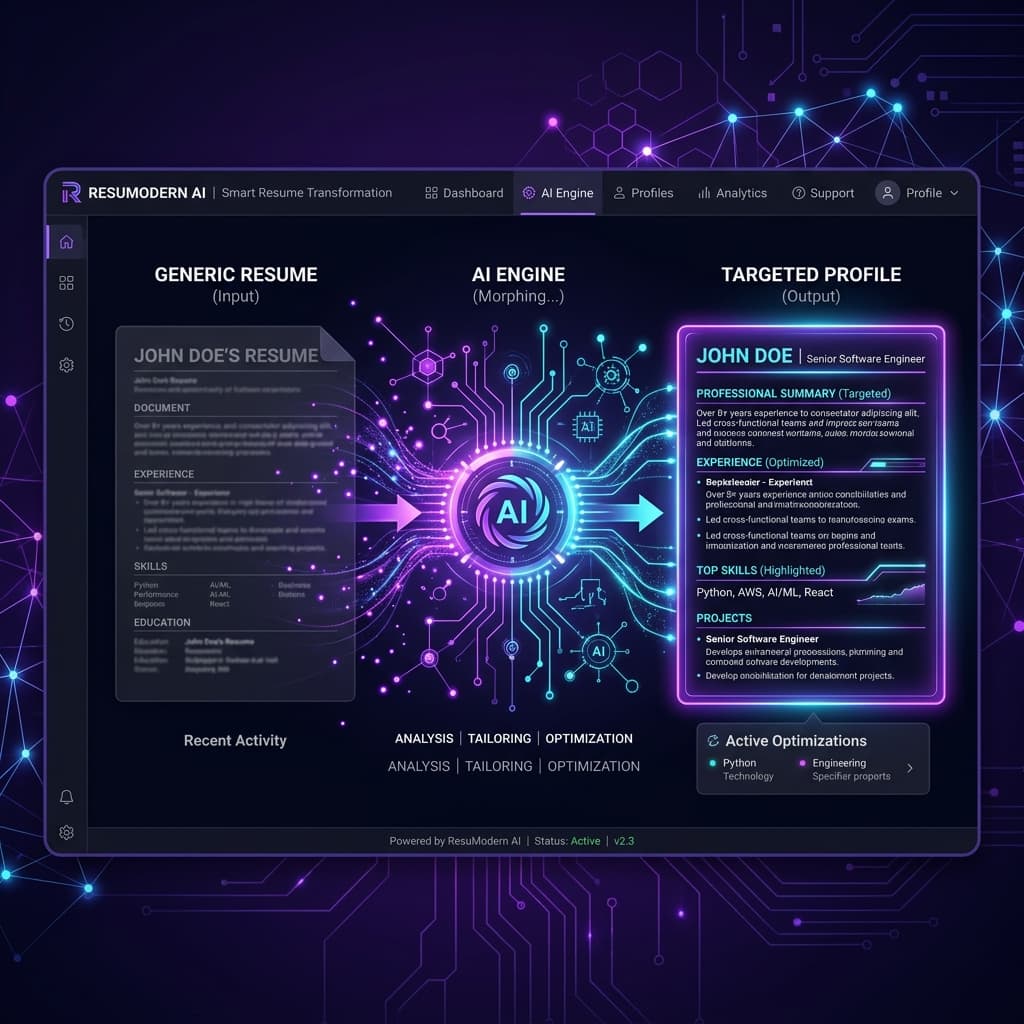
An AI resume rewrite tool works by analyzing two primary inputs: your master resume data and the target job description. The AI does not simply perform a raw "search-and-replace" keyword drop. Instead, it reads the context, identifies the core skills and competencies required, and rewrites your bullet points to naturally weave in the required vocabulary.
For instance, if a job description states: "Looking for a software engineer to optimize query execution and manage large databases."
And your raw resume bullet says: "Maintained SQL database and wrote fast code to fetch user data."
The AI rewrite engine will optimize it to read: "Managed enterprise databases and engineered optimized SQL queries to accelerate data retrieval speed by 35%."
The rewritten bullet point is completely truthful, but it is framed in the exact terminology the recruiter's search filters and the ATS parser are looking for. What used to take an hour of careful editing is now accomplished in under three seconds.
Real-World Examples of AI Bullet Optimization
To demonstrate the transformative power of AI-driven optimization, let us look at three real-world examples across different industries:
Example 1: Software Engineer
Raw Entry: "Helped build frontend web pages using React and worked with backend developer."
AI Tailored Optimization: "Collaborated with backend engineers to construct responsive, high-performance web applications using React.js, reducing load times by 18%."
Target Keywords Integrated: collaborating, backend engineers, high-performance web applications, React.js, load times.
Example 2: Account Executive (Sales)
Raw Entry: "Responsible for selling software subscriptions and talking to business leads."
AI Tailored Optimization: "Drove B2B software subscription sales by identifying qualified business leads, resulting in exceeding monthly sales targets by an average of 14%."
Target Keywords Integrated: B2B sales, software subscription sales, qualified business leads, sales targets.
Example 3: Project Manager
Raw Entry: "Led a team that did software launch projects on time."
AI Tailored Optimization: "Spearheaded cross-functional project teams through all phases of the software development lifecycle (SDLC), ensuring 100% on-time project delivery."
Target Keywords Integrated: cross-functional project teams, phases of SDLC, on-time project delivery.
Step-by-Step AI-Powered Resume Tailoring Workflow
If you want to use technology to accelerate your job hunt, here is the optimal step-by-step workflow for tailoring your resume using an AI resume builder:
- Step 1: Upload Your Master Profile. Input your full work history, educational achievements, technical certifications, and core skills. This acts as your source of truth.
- Step 2: Input the Target Job Description. Paste the text of the job description you are applying to. The AI will immediately parse the text to identify core competencies and missing keywords.
- Step 3: Review and Approve AI Suggestions. Inspect the tailored experience bullet recommendations, summary edits, and skill alignments proposed by the software.
- Step 4: Download and Submit. Export a clean, single-column, ATS-friendly PDF. Your document is now fully optimized for that specific application.
How an AI Resume Builder Streamlines Your Job Search
Using an AI resume builder to implement a tailored resume strategy provides key advantages:
- Scalability: You can apply to five different types of roles with five perfectly customized resumes without spending hours editing files.
- Error Reduction: AI systems automatically check for spelling errors, formatting breaks, and grammatical inconsistencies, ensuring your application is flawless.
- Data-Driven Matching: AI models compare your document with millions of successful resumes in their database, suggesting changes that are statistically proven to increase response rates.
- Unified Tracking: Instead of having dozens of file versions scattered across your desktop, a dedicated builder allows you to save and manage all your role-specific resumes in one centralized dashboard.
The ATS Resume Flow Advantage
At ATS Resume Flow, we have built the ultimate platform to automate the tailoring process. Our suite features a state-of-the-art AI resume builder integrated with real-time scoring and semantic analysis tools.
Here is how you can use ATS Resume Flow to customize your resumes instantly:
- Create a Master Profile: Input your entire career history, education, projects, and certifications into the builder.
- Paste a Job Description: Click the "Tailor Resume" button and paste the text of the job description you are targeting.
- Review AI Suggestions: Our AI will analyze the job requirements, calculate your match score, and present tailored bullet adjustments and keyword recommendations.
- Download with One Click: Instantly export a clean, single-column, ATS-friendly PDF optimized specifically for that application.
Stop wasting time submitting generic applications that get ignored by systems. Supercharge your career hunt and command the attention of recruitment teams. Head over to ATS Resume Flow to start optimizing your resume and landing your next round of interviews.
Instantly Check Your ATS Score
& Auto-Tailor Your Resume
Upload your resume and select your target Job Role or paste a custom Job Description. Our AI will analyze your match rate, automatically rewrite your resume to perfectly align with your target, and generate a custom cover letter—with zero manual editing required.
Upload Resume
PDF, DOCX, or TXT
Tap to upload or drop file
PDF, DOCX, or TXT
Don't have a resume?
Build a professional ATS-friendly resume from scratch in minutes.
Target
Select a Job Role to check your ATS score against that profession and have our AI optimize your resume for it. Switch to Job Description for a precise analysis.