Stop Writing Cover Letters Manually: AI Generators Explained
Introduction: The Love-Hate Relationship with Cover Letters
Ask any group of job seekers about the most frustrating part of their job search, and you will hear a consistent response: writing cover letters. The process is exhausting: researching the company, analyzing the job description, structuring a professional narrative, and attempting to strike the perfect balance between professional confidence and genuine humility.
Worse, job seekers frequently feel like their efforts are wasted. They spend hours drafting a personalized letter, submit it through an application portal, and never receive a response. They wonder: does anyone actually read these documents, or are they simply disappearing into the corporate black hole?
In 2026, the job market is faster and more competitive than ever. If you want to maximize your opportunities, you cannot afford to waste hours manually writing a unique letter for every application. However, you also cannot afford to submit generic, copy-paste templates that recruiters can spot in seconds. In this comprehensive guide, we will analyze when cover letters are critical, break down the anatomy of a high-converting letter, and show you how an AI cover letter generator can automate your workflow.
Do Recruiters Actually Read Cover Letters?
The short answer is: it depends. Studies show that approximately 50% of recruiters and hiring managers consider cover letters optional, while the other 50% state that cover letters are highly valuable and can sway their decision when choosing between two qualified candidates.
Even if a recruiter does not read your cover letter during the initial 7-second screening phase, it is frequently evaluated once you pass the initial filter. Hiring managers look at cover letters to evaluate your communication skills, understand your career narrative, and assess your cultural fit.
If an application asks for a cover letter, failing to submit one is a red flag. It signals a lack of effort, laziness, or a low level of interest in the company. To maximize your chances of selection, you should always submit an optimized cover letter with your application.
Critical Situations Where a Cover Letter is Mandatory
While always helpful, a personalized cover letter is absolutely critical in these specific scenarios:
- Making a Career Transition: If you are changing industries or roles, your resume will show experience that does not match the target job description. A cover letter allows you to connect the dots, explaining how your transferable skills qualify you for the new challenge.
- Explaining Employment Gaps: If you took time off for family, health, education, or travel, a resume might leave recruiters wondering. A cover letter provides a professional, positive context to explain gaps.
- Relocating: If you are applying to a job in a different city or state, employers might be hesitant to interview you due to relocation costs or timing. You can explain your relocation plans in your letter.
- Highly Competitive Roles: When applying to top-tier companies or high-compensation roles, hundreds of applicants have identical qualifications. A compelling cover letter is your best tool to stand out.
The Psychology of the Hiring Manager
To understand how to write a cover letter that works, you must get inside the head of the hiring manager. When they open a cover letter, they are looking for answers to three critical questions:
- Can you do the job? This is answered by pointing to specific accomplishments and tools that overlap with their requirements.
- Do you actually care about our company? This is answered by demonstrating that you have researched their products, values, and mission.
- Are you easy to work with? This is answered by writing in a clear, positive, and collaborative tone.
Most applicants write cover letters focused on their own needs: "This job would be a great step for my career." A hiring manager wants to know what you can do for the company, not what the company can do for you. Transitioning your cover letter from candidate-focused to company-focused will immediately place your application in the top 5% of candidate lists.
Three Hook Styles to Grab Recruiter Attention Instantly
The opening paragraph of your cover letter must grab the recruiter's attention immediately. Here are three customizable hook templates targeting different profiles:
A. The Direct, Data-Driven Hook
"As a software engineer with 5 years of experience optimization database pipelines, I was thrilled to see the Senior Backend role at ATS Tech. During my time at CloudCorp, I refactored Redis cache layers to scale transaction traffic by 30%, and I am eager to deliver identical performance optimization achievements to your engineering team."
B. The Core Values & Mission Hook
"I have followed EcoTech's solar tracking product development for the past two years, and your commitment to grid democratization aligns directly with my career mission. As a Project Manager, I would love the chance to apply my Agile Scrum coordination methodologies to streamline your hardware launches."
C. The Career Transition Narrative Hook
"After a successful 6-year career in classroom teaching, where I designed complex curriculums and coordinated weekly progress reports for 120+ stakeholders, I am transitioning my training into the Corporate Instructional Designer position. I look forward to leveraging my educational design methodologies to scale your staff training programs."
The Problem with Generic Templates
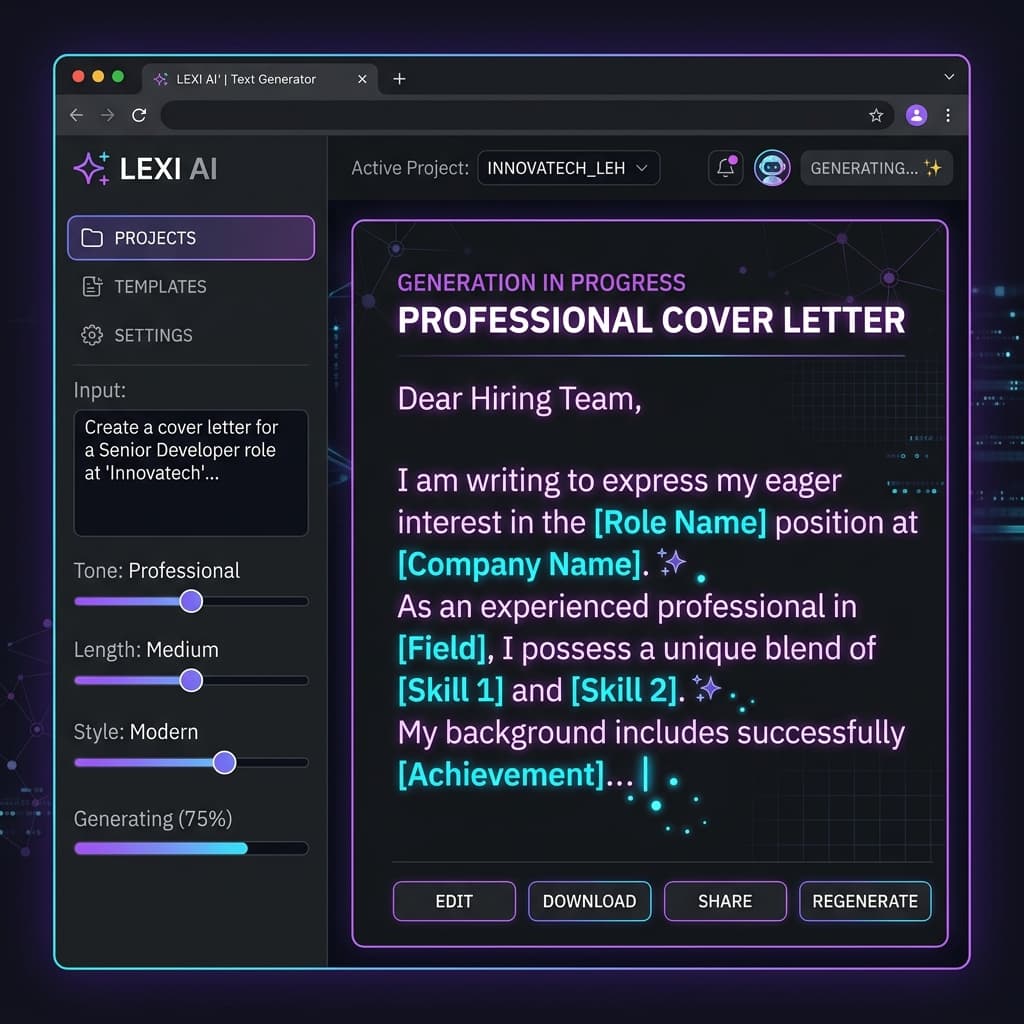
To save time, many job seekers use standard, fill-in-the-blank cover letter templates: "Dear Hiring Manager, I am writing to express my interest in the [Job Title] role at [Company Name]..."
Recruiters read hundreds of letters a week. They can spot these template paragraphs instantly. A generic letter signals that you are sending the exact same file to dozens of companies and do not care about this specific role. It is better to write no cover letter at all than to submit a lazy, generic template.
The Anatomy of a Compelling Cover Letter
A persuasive, high-converting cover letter should fit on a single page (250 to 350 words) and follow a structured narrative:
- The Header: Clear, professional contact details aligning with your resume's visual layout.
- The Salutation: Address the hiring manager by name (e.g., "Dear Ms. Smith"). If you cannot find their name, use a professional team greeting like "Dear Product Design Hiring Team" instead of "To Whom It May Concern."
- The Hook (Opening Paragraph): State the role you are applying for and lead with an engaging, achievement-oriented statement. Show immediate enthusiasm for the company's mission.
- The Evidence (Body Paragraphs): Highlight 1 to 2 specific accomplishments from your work history that directly match the requirements of the job description. Do not repeat your resume; tell a brief, high-impact story.
- The Match (Company Alignment): Explain exactly why you want to work for this specific company. Cite a recent milestone, company value, or product that resonates with you.
- The CTA & Closing: Reiterate your value proposition, state your availability for an interview, thank them for their time, and close with a professional salutation.
How an AI Cover Letter Generator Works
The challenge is clear: you need highly personalized, role-specific letters, but writing them manually takes too long. This is where a custom cover letter AI comes in.
An AI cover letter generator works by mapping the semantic relationship between your resume history and the target job description. It identifies the overlapping skills, achievements, and requirements, and writes a tailored narrative.
Instead of generic templates, modern AI tools write natural, cohesive, and professional letters that read like a professional career writer drafted them. The generator ensures your formatting is flawless, your tone is appropriate, and your keywords match the listing perfectly.
AI Semantic Mapping under the Hood: How Systems Align Content
Under the hood, a high-quality AI cover letter generator does not just insert names into a template. It relies on LLM prompt engineering and semantic indexing. When you trigger the tool, the AI executes a multi-step inference pipeline:
- Entity Extraction: The software scans the job posting to locate target requirements (e.g., "minimum 3 years in React", "ability to lead Agile ceremonies").
- Relevance Mapping: The system query-matches these requirements against your resume database fields, selecting the top 2 matching accomplishments from your work history.
- Stylistic Drafting: The LLM drafts the cover letter body using an active voice, formatting it inside a classic business communication structure.
This automated alignment is what makes the generated document look completely custom. To a hiring manager, the letter reads as if you spent hours researching their open ticket and carefully choosing your matching achievements to prove your candidacy.
Controlling Tone and Voice in AI Writing
One of the biggest concerns about using AI tools is that the output can sound robotic or generic. To write an authentic, high-impact cover letter, you must direct the AI's tone:
| Tone Style | Characteristics | Best For |
|---|---|---|
| Formal/Corporate | Highly professional vocabulary, respectful salutations, and conservative syntax structures. Focuses heavily on institutional hierarchy. | Finance, Banking, Legal, Consulting, and Enterprise Companies. |
| Startup/Creative | Energetic storytelling, conversational language, and passion for the product or service. Focuses heavily on personal mission. | Early-stage Startups, Marketing Agencies, and Creative Design Studios. |
| Technical/Direct | Focuses strictly on coding stacks, methodologies, certifications, and hard numerical impact data. Minimizes emotional fluff. | Software Development, Systems Engineering, Data Analytics, and Research. |
Tailoring the Cover Letter's Call-to-Action
The final paragraph of your cover letter must prompt action without sounding overly aggressive. Instead of a passive ending like "I hope to hear from you soon," use a proactive call-to-action that indicates your readiness for discussion:
"I welcome the opportunity to discuss how my experience in building Redis cache layers and Python ETL pipelines can support your backend scaling goals. I am available for an interview at your convenience and look forward to speaking with the team."
Directing the AI's Narrative Focus: Injecting Key Anecdotes
To get the best possible output from an AI cover letter generator, do not just rely on its default settings. You should provide brief contextual prompts. If you have a specific project you are proud of, or if you have a unique reason for a career change, feed this context into the generator's instruction prompt (e.g., "Focus heavily on my experience refactoring database query optimization lines" or "Highlight my background launching products in the solar tracking field").
This allows the AI to select the optimal semantic blocks from your resume and frame them around that specific project. It prevents the cover letter from reading like a standard list of resume highlights and transforms it into a cohesive narrative built around a single theme.
AI Cover Letter Editing: Finding and Deleting AI Clichés
AI models tend to overuse certain words and phrases. When reviewing an AI-generated letter, keep an eye out for terms like "delighted," "thrilled," "testament," "nestled," "beacon," or "delve."
To make your letter sound completely human and authentic, replace these words with direct and natural language. For instance, instead of saying, "My career is a testament to my dedication to clean code," rewrite it to read, "Throughout my career, I have prioritized writing clean, maintainable code." This subtle editing step removes any artificial tone and gives the text a genuine voice that hiring managers appreciate.
AI Cover Letter Optimization Checklist
Before you click submit on your cover letter, run through this 10-point checklist to make sure your cover letter is completely optimized for recruiter success:
- Did you address a specific hiring manager or departmental team?
- Is the opening hook accomplishment-oriented and engaging?
- Are there exactly 1 to 2 body paragraphs highlighting quantifiable work achievements?
- Did you explain your alignment with the company's specific mission or product?
- Is the entire letter kept within a single page (under 400 words)?
- Is the tone (Formal, Startup, Technical) tailored to the company's culture?
- Have you avoided repeating sentences directly from your resume?
- Is the document design (margins, font choice) identical to your resume?
- Did you verify there are no grammatical errors or formatting issues?
- Does the call-to-action express enthusiasm and request a follow-up discussion?
Generating Cover Letters Instantly with ATS Resume Flow
At ATS Resume Flow, we have integrated a state-of-the-art AI cover letter generator directly into our platform.
Our tool takes your saved resume profile and the target job description to build a custom cover letter in under 5 seconds. You can easily adjust the tone, rewrite sections, and export a clean PDF matching your resume's style.
Stop staring at a blank page. Go to our Resume & Letter Builder, paste your target job details, and download a custom letter that landing your next round of interviews.
Instantly Check Your ATS Score
& Auto-Tailor Your Resume
Upload your resume and select your target Job Role or paste a custom Job Description. Our AI will analyze your match rate, automatically rewrite your resume to perfectly align with your target, and generate a custom cover letter—with zero manual editing required.
Upload Resume
PDF, DOCX, or TXT
Tap to upload or drop file
PDF, DOCX, or TXT
Don't have a resume?
Build a professional ATS-friendly resume from scratch in minutes.
Target
Select a Job Role to check your ATS score against that profession and have our AI optimize your resume for it. Switch to Job Description for a precise analysis.