Resume Tailor: How to Match Your Resume to Any Job Description in 30 Seconds
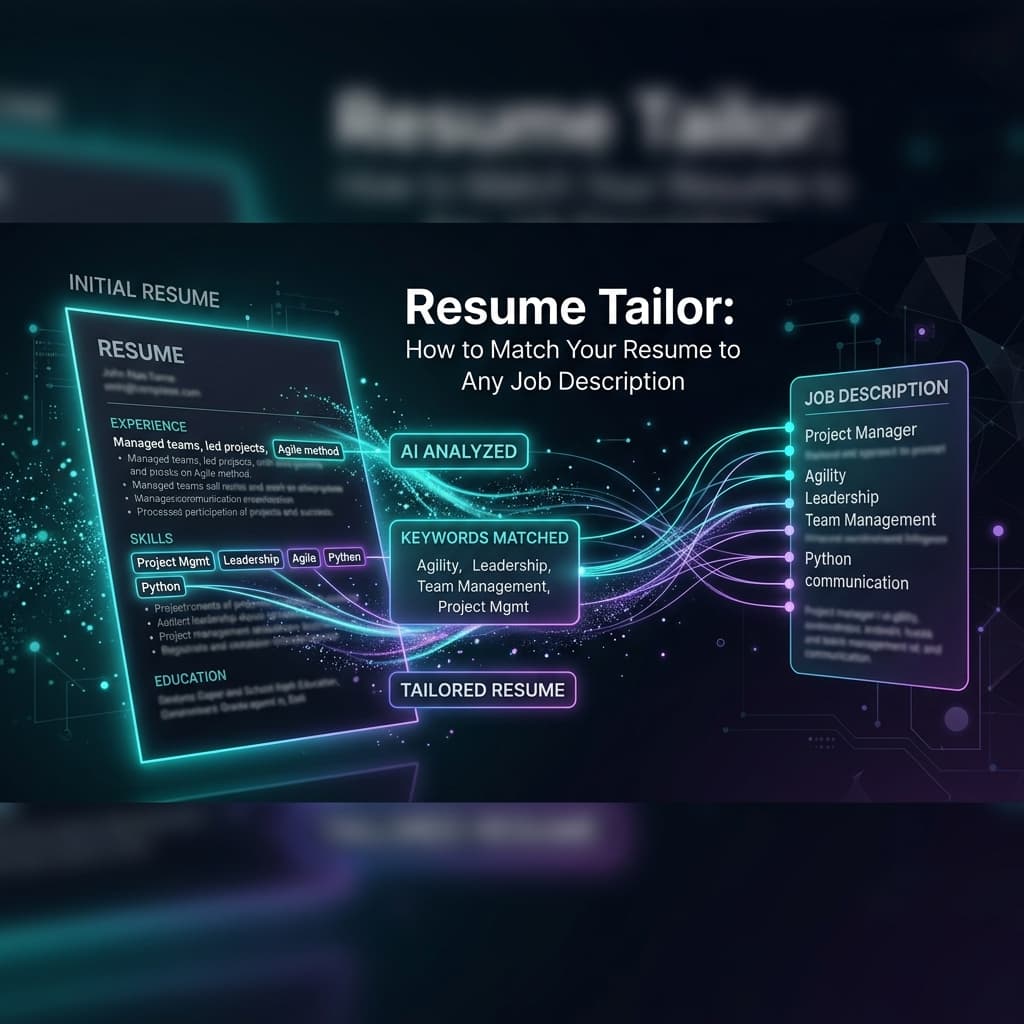
Why Tailoring Your Resume is No Longer Optional
In today's hiring landscape, the question is no longer whether you should tailor your resume to each job — it is how fast you can do it. With over 98% of Fortune 500 companies using Applicant Tracking Systems (ATS) to filter candidates, a generic resume submitted to dozens of jobs will score poorly across nearly every single one. The ATS is not evaluating your general career worth; it is measuring how precisely your document matches the specific vocabulary, skills, and requirements of the job description in front of it.
Research from job platform analytics consistently shows that candidates who submit a tailored resume to job description are 3x more likely to receive a callback than those who use a single generic version. Despite this widely available knowledge, 72% of applicants still send the same resume to every role — because the manual tailoring process is time-consuming, tedious, and requires a deep knowledge of SEO-style keyword optimization.
This article will break down exactly what tailoring means, how it works technically inside the ATS, and — most importantly — how AI can compress a 90-minute manual workflow into a 30-second automated process using a professional AI resume tailor.
What Does "Tailoring a Resume" Actually Mean?
Tailoring your resume is the practice of strategically adjusting its content, language, and structure to align with the specific requirements of a job listing. It is not fabrication — it is presentation. You are not inventing skills you do not have; you are surfacing and framing the skills you do have in the exact language the employer uses to describe them.
There are four primary dimensions to a well-tailored resume:
- Keyword Alignment: Integrating the precise terms from the job description into your resume text, particularly in the Professional Summary, Skills section, and Experience bullet points.
- Skill Prioritization: Reordering your skills section to lead with the competencies the employer prioritizes most, based on how often they appear in the listing and how prominently they are featured.
- Bullet Point Reframing: Adjusting the language of your accomplishments to highlight the outcomes the specific employer cares about (e.g., if the role emphasizes "customer retention," your bullet should explicitly mention retention metrics).
- Professional Summary Targeting: Rewriting the opening 3-4 lines of your resume to directly echo the job's core requirements and the company's mission or tone.
The Technical Reason Keyword Matching Matters So Much
To understand why keyword alignment is critical, you need to understand how the ATS scores your resume. When a recruiter creates a job posting in a system like Workday, Greenhouse, or Taleo, the platform automatically generates a weighted keyword profile from the job description text. Terms that appear more frequently and in prominent positions (like the job title or "Required Skills" section) receive higher importance weights.
When your resume is uploaded, the parser extracts your text and runs an intersection algorithm — calculating which of the job's weighted keywords appear in your document, how frequently, and in what context. Your ATS score is essentially a measure of that intersection. The closer your vocabulary is to the job's vocabulary, the higher your score — and the higher your position on the recruiter's ranked candidate leaderboard.
| Resume Version | Keyword Match | ATS Score | Recruiter Visibility |
|---|---|---|---|
| Generic Resume | 38% match | 48 / 100 | Buried on page 4+ |
| Lightly Tailored | 62% match | 71 / 100 | Page 2 consideration tier |
| AI Tailored Resume | 89% match | 91 / 100 | Top 3 candidates shortlisted |
Step-by-Step: How to Manually Tailor a Resume (and Why It's Inefficient)
Before exploring the AI approach, it helps to understand the manual workflow so you appreciate the value of automation:
- Print or open the job description in a separate window. Read it end-to-end, underlining skills, tools, methodologies, and soft skills that are stated as requirements.
- Open your resume in a word processor. Open both documents in a split-screen view.
- Do a gap analysis. Compare your current skills list against the highlighted job requirements. Note every skill or term on the JD that does not appear in your resume.
- Rewrite your Professional Summary. Replace generic language with phrases that echo the job posting's language and company mission.
- Edit each experience bullet. Go bullet-by-bullet through your work history, inserting relevant missing keywords and reframing outcomes to align with what the employer values.
- Reorder your Skills section. Move the skills that match the JD's top requirements to the beginning of your skills list.
- Export and rename the file. Save the tailored version with a role-specific filename (e.g., "Jane_Doe_ProductManager_Stripe.pdf").
Done properly, this process takes 45–90 minutes per application. Multiply that by 15–20 applications per week, and you are spending more than 20 hours a week just on resume customization. Most job seekers give up within 2 weeks and revert to the generic resume — guaranteeing lower response rates.
How an AI Resume Tailor Compresses 90 Minutes Into 30 Seconds
A modern AI resume tailor eliminates every manual step in the workflow above. The technology works by taking two inputs — your resume and the target job description — and performing the following operations automatically:
1. Semantic Keyword Extraction
The AI reads the entire job description, identifies hard skills, soft skills, methodologies, tools, and implicit requirements. It builds a weighted relevance map of terms to integrate.
2. Gap Analysis Against Your Resume
The system compares the extracted keyword map against your existing resume text, categorizing every required term as "present," "partially present," or "missing."
3. Natural Language Rewriting
For each missing or underrepresented keyword, the AI rewrites your relevant experience bullets to naturally integrate the terms — preserving truthfulness while maximizing keyword density and readability.
4. Summary and Title Optimization
The Professional Summary is regenerated to mirror the job title, company tone, and top 3-5 priority requirements identified in the description.
Real Transformation Example: Before and After AI Tailoring
Here is a direct comparison of a resume bullet before and after AI tailoring for a Data Science role:
❌ Before (Generic)
"Worked on data projects and built reports for the management team using various tools."
ATS Score for this bullet: ~22%
✅ After (AI Tailored)
"Engineered end-to-end machine learning pipelines in Python (scikit-learn, pandas) and developed executive dashboards in Tableau, reducing reporting cycle time by 40%."
ATS Score for this bullet: ~91%
The ATS Resume Flow Tailoring Suite
ATS Resume Flow includes a purpose-built AI Resume Tailor that processes your resume against any job description and produces a complete, fully optimized document in under 30 seconds. The system outputs a full rewrite — not just keyword suggestions — with a live ATS score update showing you exactly how the tailored version scores compared to your original.
Upload your resume once. Paste any job description. Get a fully tailored, ATS-optimized version instantly — ready to download and submit. This is the same advantage that high-performing executive job seekers have used for years, now available to every professional at scale.
Instantly Check Your ATS Score
& Auto-Tailor Your Resume
Upload your resume and select your target Job Role or paste a custom Job Description. Our AI will analyze your match rate, automatically rewrite your resume to perfectly align with your target, and generate a custom cover letter—with zero manual editing required.
Upload Resume
PDF, DOCX, or TXT
Tap to upload or drop file
PDF, DOCX, or TXT
Don't have a resume?
Build a professional ATS-friendly resume from scratch in minutes.
Target
Select a Job Role to check your ATS score against that profession and have our AI optimize your resume for it. Switch to Job Description for a precise analysis.