One Resume vs. Multiple Tailored Resumes: Why a Targeted Strategy Wins Every Time
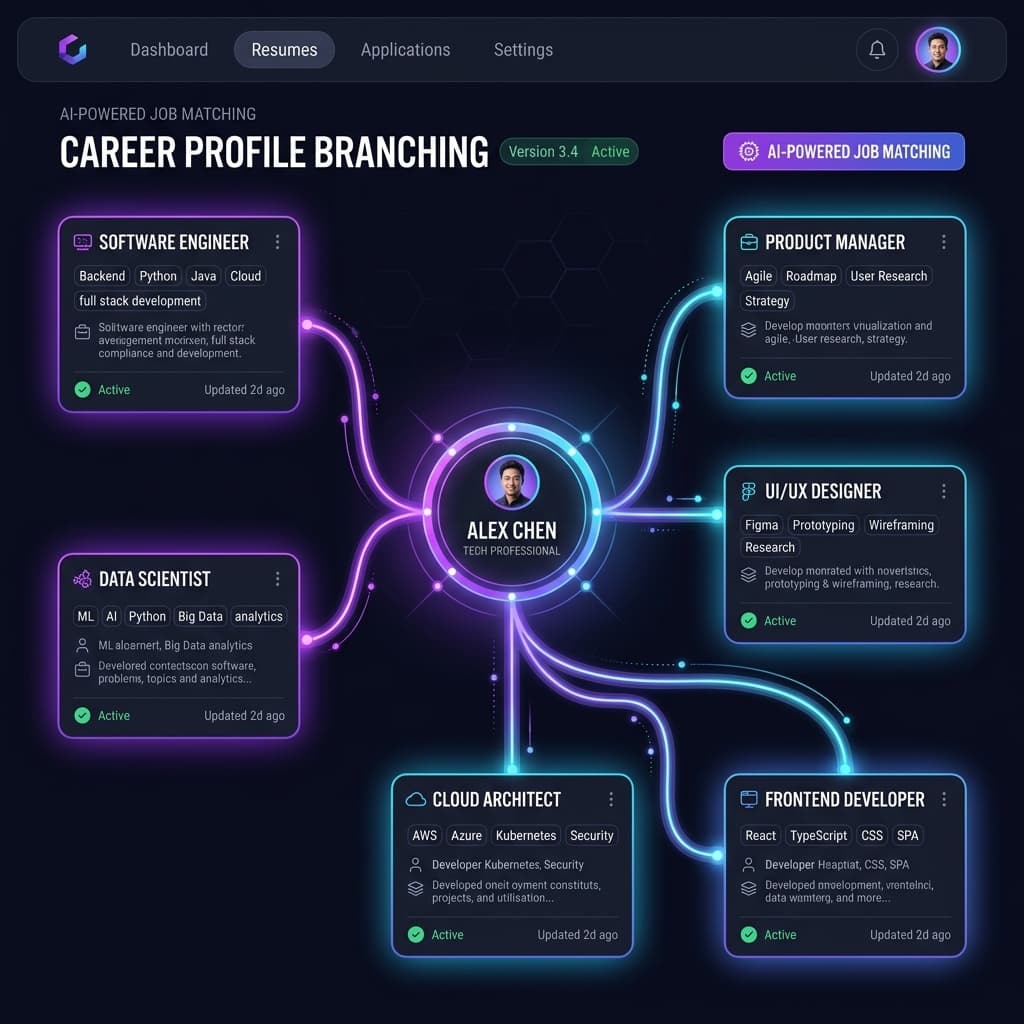
The Common Mistake 95% of Job Seekers Make
Picture this: You have a solid background in software engineering, but you've also done project management, and you're open to data analyst roles. So you write one comprehensive resume that tries to cover all of it — every tool, every responsibility, every skill crammed onto two pages — and you blast it to 50 different jobs.
The result? Silence. No callbacks. Maybe one or two polite rejections. It's not because you're unqualified. It's because your resume is unfocused, and Applicant Tracking Systems (ATS) can tell.
This is the single most common mistake job seekers make in 2026: treating one resume as a universal key that opens every door. In reality, every job is a different lock, and you need a key specifically cut for it.
By compiling your entire career history into a single, multi-purpose document, you dilute the impact of your achievements. Instead of standing out as a specialist who is uniquely qualified for the role, you appear to be a generalist who does not have a clear career direction. To maximize your chances of getting hired, you must implement a multi-resume strategy.
How ATS Scoring Works Against a Generic Resume
When a recruiter posts a Software Engineer role, their ATS is configured to look for specific signals: programming languages (Python, React, TypeScript), methodologies (Agile, CI/CD), and tools (GitHub, Docker). The system gives your resume a relevance score based on how many of those specific signals it finds.
Now, if your resume is split between engineering, project management, and data analysis content, it's diluted. The ATS might only find 12 out of 20 required engineering signals — not because you don't have the skills, but because the resume is talking about too many other things at the same time.
A candidate with a laser-focused, engineering-specific resume will score 18/20 on the same scan — and they get the interview. You don't.
This is because the ranking algorithm uses keyword density and semantic proximity to judge alignment. If your tech stack listing is surrounded by project coordination terms, the parser assumes engineering is only a secondary skill, which lowers your leaderboard score.
The Multiple Resume Strategy: A Proven Approach
Professional recruiters and career coaches universally agree: maintaining separate, role-specific resumes is the highest-leverage tactic available to a job seeker. Here is exactly how to structure this strategy:
Step 1: Identify Your Target Job Families
Group your target roles into 2–4 "job families." For example:
- Job Family A: Frontend/Full-Stack Software Engineer roles
- Job Family B: Technical Product Manager / Engineering Manager roles
- Job Family C: Data Analyst / Business Intelligence roles
Each of these families has a different vocabulary, a different emphasis, and different must-have keywords. They each deserve their own dedicated resume.
Step 2: Create a Master Resume as Your Foundation
Start by building one comprehensive "master" document that includes every role, every skill, and every achievement you've had. This is not a document you ever send to an employer — it is your content library. Think of it as a full inventory of your career capital.
Step 3: Craft Targeted Versions from the Master
For each job family, create a separate resume by selecting only the most relevant sections from your master document. Each targeted resume should:
- Lead with the right experience: Put the most relevant role at the top, even if it wasn't your most recent position (use a functional or hybrid format if needed).
- Rewrite bullet points with the right language: A "data pipeline" becomes a "Python ETL workflow" for the data engineer role, and an "automated reporting system" for the analyst role.
- Trim irrelevant content: Remove skills and experiences that dilute your message. A focused 1-page resume often outperforms a jam-packed 2-page one.
- Update the summary section: Your professional summary should directly speak to the job family you're targeting.
Step 4: Fine-Tune for Each Individual Application
Your "Software Engineer" resume is a strong base, but applying to Google is different from applying to a 10-person startup. Before you submit, spend 5 minutes doing a quick keyword scan of the specific job description. Add any missing keywords, adjust your summary, and check the tone. This micro-tailoring on top of your already-targeted resume is what pushes your ATS score from 75% to 90%+.
The Data: What Targeted Resumes Actually Do to Your Chances
Research from major recruitment platforms consistently shows the impact of targeted resumes:
- Job seekers who tailor their resume for each application are up to 3x more likely to receive an interview invitation.
- Resumes with an ATS match score above 80% are reviewed by a human recruiter at a rate 4.5x higher than those below 60%.
- The average recruiter spends only 7 seconds on an initial resume review. A focused, targeted resume communicates your value instantly.
Applying to Multiple Job Types: A Practical Example
Let's say you're a marketing professional who has experience in content strategy, paid advertising (PPC), and SEO. You want to apply to three different types of roles:
- Content Marketing Manager — This resume leads with your content strategy, editorial calendar management, and brand voice development. It highlights metrics like organic traffic growth and content conversion rates.
- Performance Marketing Manager (PPC) — This resume leads with your paid ad campaign management, ROAS figures, A/B testing results, and platform certifications (Google Ads, Meta Ads).
- SEO Manager — This resume leads with keyword research, technical SEO audits, backlink strategy, and ranking improvements demonstrated with data.
All three resumes are truthful. All three are based on your actual experience. But each one is speaking the specific language of that employer, which means the ATS scores you high and the recruiter sees an obvious fit — not a generalist who might be able to do the job.
The Common Objection: "That's Too Much Work"
This is the most frequent pushback to this strategy, and it used to be a valid concern. Creating and maintaining 3–4 versions of a resume manually, and then fine-tuning each one for every single application, would genuinely take an enormous amount of time.
This is precisely why AI resume tools exist. With a platform like ATS Resume Flow, you can:
- Build and save multiple role-specific resumes in one dashboard under "My Resumes."
- Paste any job description and instantly get an AI-generated, tailored version of your resume in seconds.
- Scan each tailored version against the job description and get a real ATS score so you know exactly where you stand before you apply.
What used to take an hour of manual work now takes under 2 minutes. The excuse of "it takes too long" is no longer valid.
Summary: Your Multiple-Resume Action Plan
- Identify the 2–4 distinct job types you are targeting.
- Build a master resume with all your experience.
- Create a focused, role-specific version for each job family.
- Use an AI tool to micro-tailor each version before submitting.
- Scan every version against the ATS before you apply to ensure you score above 80%.
This is not a "nice to have" strategy. In a competitive job market where every role receives hundreds of applications, a targeted resume is your most powerful competitive advantage.
Instantly Check Your ATS Score
& Auto-Tailor Your Resume
Upload your resume and select your target Job Role or paste a custom Job Description. Our AI will analyze your match rate, automatically rewrite your resume to perfectly align with your target, and generate a custom cover letter—with zero manual editing required.
Upload Resume
PDF, DOCX, or TXT
Tap to upload or drop file
PDF, DOCX, or TXT
Don't have a resume?
Build a professional ATS-friendly resume from scratch in minutes.
Target
Select a Job Role to check your ATS score against that profession and have our AI optimize your resume for it. Switch to Job Description for a precise analysis.