Job Match Analysis: How AI Determines If You Are the Right Candidate
The Invisible Ranking System Behind Every Job Application
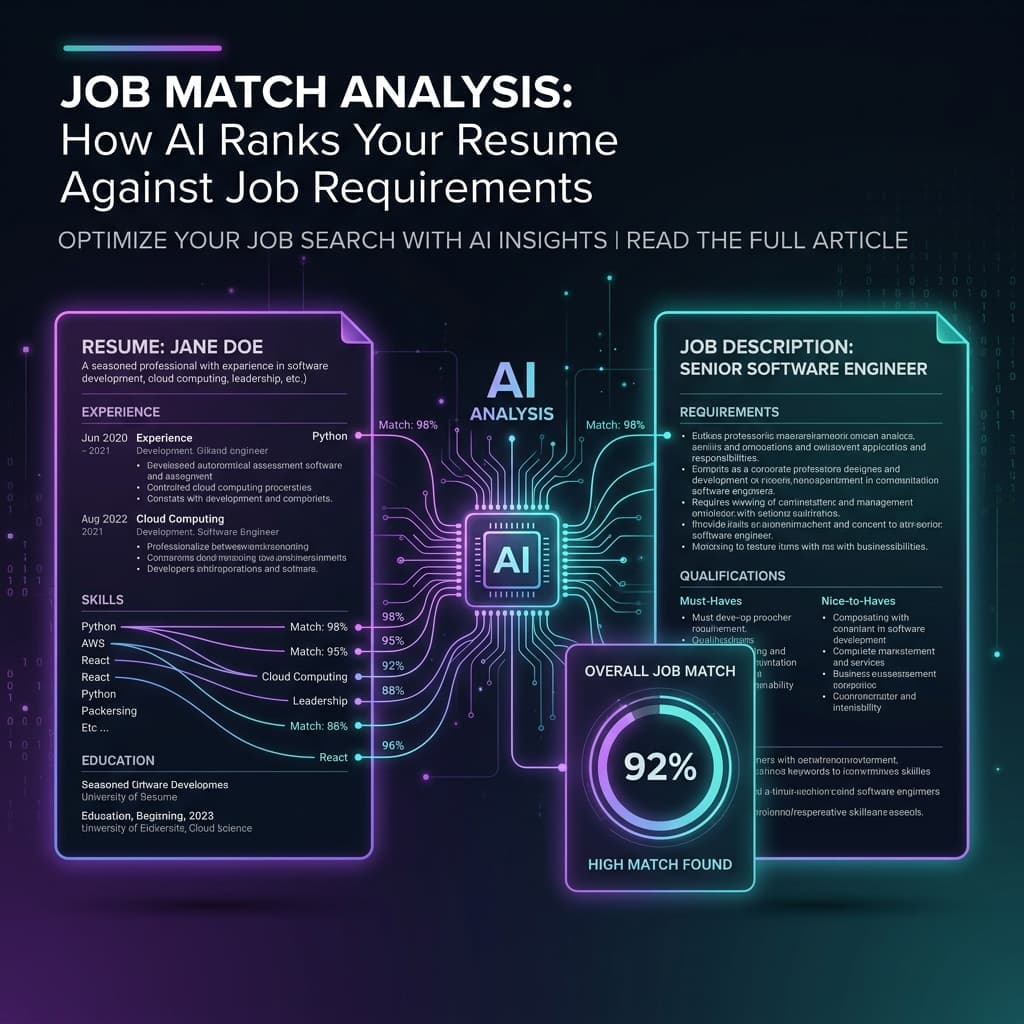
When you apply for a job online, you are not just submitting a resume — you are entering an automated ranking competition. Behind the "Apply Now" button is a sophisticated AI system that processes your application, compares it against hundreds of other candidates, and assigns it a compatibility score. This process is called job match analysis, and it is the primary mechanism by which modern corporations decide whose resume actually gets read by a human.
Understanding this system — how it works, what factors it weights, and how to engineer your resume to rank highly — is one of the most high-leverage skills a professional can develop. In this guide, we will dissect the AI-driven job match analysis process from the inside out, revealing the exact mechanics that determine your candidate ranking.
The Three-Layer Architecture of AI Job Matching
Modern enterprise ATS platforms use a layered AI architecture to evaluate candidates:
Layer 1: Structural Parsing
Before any matching occurs, the system must successfully parse your resume into structured data fields. It extracts your name, contact information, job titles, company names, employment dates, education details, and skills into a normalized database record. If your formatting prevents accurate parsing — through multi-column layouts, graphics, or text boxes — your data is corrupted and your match score is capped artificially low regardless of your qualifications.
Layer 2: Keyword and Skill Matching
The second layer compares the extracted data against the job requirements using keyword matching algorithms. This layer operates on two sub-levels:
- Hard Requirement Filters: Must-have criteria like years of experience, required certifications, and mandatory technical skills. Failing any hard filter eliminates your application before the ranking phase.
- Soft Requirement Scoring: Nice-to-have skills, preferred qualifications, and industry keywords that contribute to your overall match score but do not automatically disqualify you.
Layer 3: Semantic Similarity Analysis
The most sophisticated layer uses Natural Language Processing (NLP) and semantic embedding models to evaluate conceptual alignment between your experience and the role requirements. This is where systems like those used by Google, Amazon, and Microsoft go beyond simple keyword matching to assess whether you truly understand the domain, even if you use slightly different terminology.
What Factors Does Job Match Analysis Actually Measure?
Hard Skill and Tool Keyword Coverage
The proportion of the job's required technical skills that are explicitly present in your resume. This is the highest-weight factor in most scoring algorithms.
Experience Relevance and Recency
How closely your job titles and industry experience match the role. Experience in the same domain within the past 3-5 years scores highest.
Education and Certification Alignment
Whether your educational credentials meet or exceed stated requirements, and whether you hold any explicitly requested certifications (PMP, AWS, CPA, etc.).
Semantic Context and Domain Depth
The richness and accuracy of how you describe your experience. Bullets with metrics, methodology names, and outcome language score higher than vague descriptions.
Document Parseability and Format Integrity
How cleanly the parser extracted your data. Formatting errors corrupt the structured data used in matching, artificially capping your score.
How to Engineer Your Resume for Top-Tier Job Match Scores
Based on the scoring architecture above, here is the optimized strategy for maximizing your job match analysis score:
- Audit every hard requirement first. Read the job description and highlight every skill listed as "Required" or "Must have." Ensure each one appears in your resume with explicit, contextual usage — not just as a one-word entry in a Skills list.
- Mirror the job title in your summary. If you have held this role before, lead your Professional Summary with the exact job title from the description. This is the single fastest way to boost your Layer 1 parsing score.
- Quantify everything possible. The semantic analysis layer is trained on high-performing resumes that use metrics, percentages, dollar amounts, and team sizes. Every bullet that currently lacks a number should be revised to include one.
- Use both the long form and the acronym for certifications and tools. Write "Project Management Professional (PMP)" and "Amazon Web Services (AWS)" to capture both the short-form and long-form keyword variants in a single line.
- Clean up your document formatting. Switch to a single-column layout, remove tables and text boxes, and place all contact information in the main body of the document — not the header.
Run a Professional Job Match Analysis Before Every Application
ATS Resume Flow provides a professional-grade job match analysis tool that simulates enterprise ATS scoring. Upload your resume, paste the job description, and receive a complete breakdown of your match score — including which hard skills you are missing, which sections need improvement, and exactly how you rank compared to the role's benchmark threshold.
Stop applying blindly and hoping your resume makes the cut. Know your score before you submit. Fix it in seconds with AI. Apply with the confidence that your name will appear on the recruiter's shortlist.
Instantly Check Your ATS Score
& Auto-Tailor Your Resume
Upload your resume and select your target Job Role or paste a custom Job Description. Our AI will analyze your match rate, automatically rewrite your resume to perfectly align with your target, and generate a custom cover letter—with zero manual editing required.
Upload Resume
PDF, DOCX, or TXT
Tap to upload or drop file
PDF, DOCX, or TXT
Don't have a resume?
Build a professional ATS-friendly resume from scratch in minutes.
Target
Select a Job Role to check your ATS score against that profession and have our AI optimize your resume for it. Switch to Job Description for a precise analysis.