How Do You Tailor a Resume to a Job Post? The Exact Step-by-Step Method
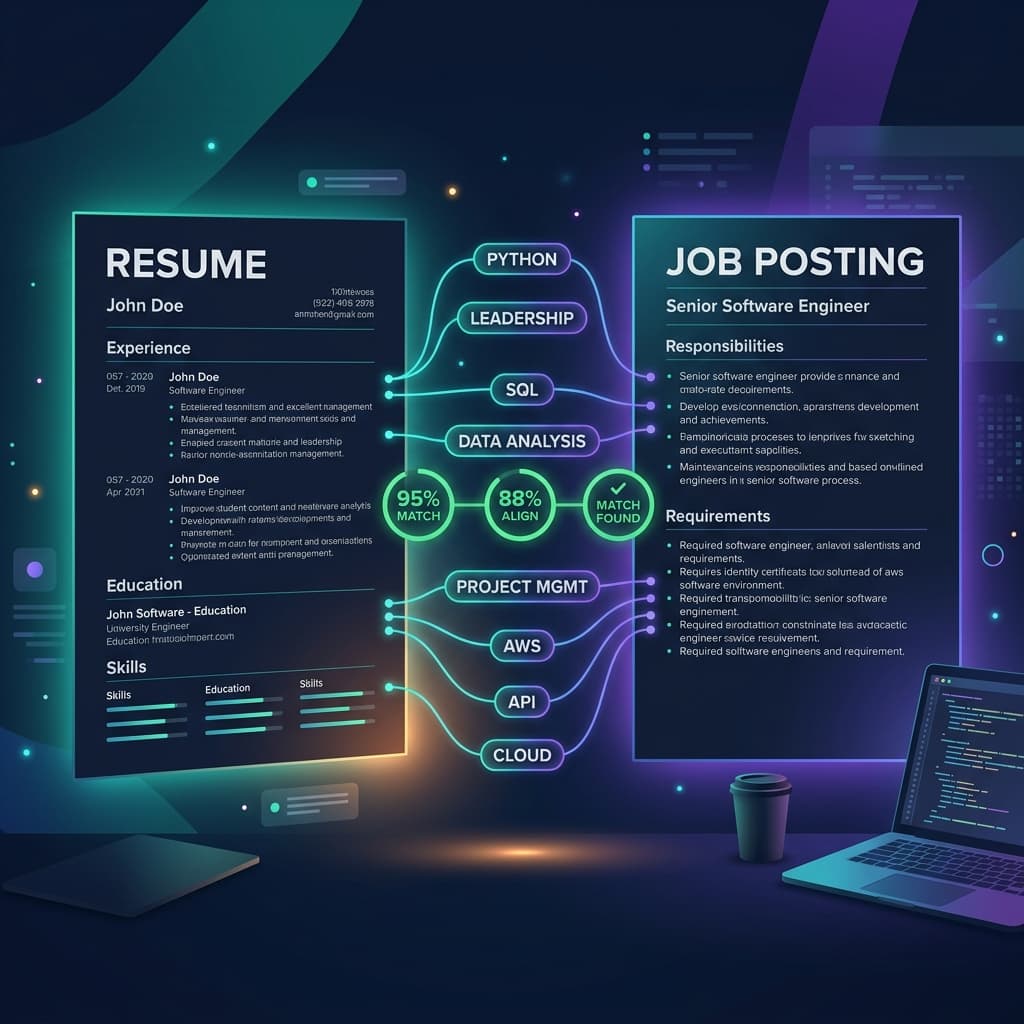
You already know you should tailor your resume for every job. But knowing it and actually doing it efficiently — that is where most people get stuck. Here is the exact method, step by step.
Why Tailoring Your Resume Is Non-Negotiable in 2026
A generic resume sent to every job posting is the most common — and most costly — mistake in a modern job search. Here is why: when you apply through an online portal, your resume is first evaluated by an Applicant Tracking System (ATS). The ATS compares your document against the job description and calculates a match score. Candidates who score above the threshold (typically 70-80%) get reviewed by a human recruiter. Everyone below that threshold is automatically archived.
A generic resume might score 45-55% against any given job posting. The same resume, properly tailored, can score 85-92%. That difference is everything. It is the difference between radio silence and a recruiter calling you within 48 hours. Tailoring is not optional — it is the fundamental strategy that separates candidates who get interviews from those who do not.
The challenge is time. Tailoring properly takes 45-90 minutes per application when done manually. For an active job seeker sending 10-20 applications per week, that is unsustainable — which is why AI-powered tailoring tools have become indispensable. But first, let us understand the exact method so you know precisely what the AI is doing for you.
Step 1: Analyse the Job Post Before Touching Your Resume
The biggest mistake people make when tailoring a resume is diving straight into editing. Before you change a single word, spend 10 minutes deeply analysing the job posting. You are looking for three layers of information:
Layer 1: Hard Requirements (Must-Haves)
These are non-negotiable qualifications: specific software, certifications, years of experience, or technical skills explicitly stated as required. Highlight every one of these. If you have them, they must appear in your resume using the exact same terminology.
Layer 2: Preferred Keywords (Differentiators)
Skills, tools, and experience listed as "preferred" or "nice to have." These are your opportunity to pull ahead of other candidates with similar hard requirements. If you have any of these, include them prominently.
Layer 3: Cultural & Contextual Language
Pay attention to the words and phrases the company uses to describe the role. "Customer obsession," "bias for action," "scrappy and entrepreneurial" — these phrases signal company culture and values. Weave their language into your professional summary to demonstrate cultural fit.
Step 2: Map the Job Requirements Against Your Experience
Create a simple three-column comparison before editing your resume:
| Job Requirement | Your Experience | Action Needed |
|---|---|---|
| "Agile project management" | You use Scrum but wrote "iterative sprints" | Reword to match exact phrase |
| "Salesforce CRM" | You listed "CRM tools" in Skills | Replace with "Salesforce CRM" specifically |
| "Cross-functional leadership" | You mention "working with different teams" | Use the exact phrase in a relevant bullet |
| "Data-driven decision making" | Not mentioned anywhere in your resume | Add to Summary and a relevant bullet |
This mapping exercise reveals your keyword gaps precisely. It tells you exactly what to add, what to reword, and what already matches. The goal of the tailoring process is to close every gap on this list.
Step 3: Rewrite Your Professional Summary to Mirror the Role
Your professional summary is the highest-priority tailoring target. It is the first thing both ATS systems and human recruiters read. For each job application, you should have a version of your summary that:
- Opens with the exact job title from the posting (or very close to it) — ATS systems score job title matches heavily
- References your years of experience in the relevant domain
- Incorporates 2-3 of the most critical keywords from the job's required skills section
- Includes a specific, quantified achievement that demonstrates your ability to deliver the outcomes the employer needs
- Reflects the company's cultural language if you identified any in Step 1
Tailor Your Resume to Any Job Post in Seconds — AI Does It For You
Paste your resume and the job description below. Our AI instantly identifies every keyword gap, rewrites your resume to match the exact requirements of the role, and calculates your ATS match score — so you know you are submitting the strongest possible application.
Upload Resume
PDF, DOCX, or TXT
Tap to upload or drop file
PDF, DOCX, or TXT
Don't have a resume?
Build a professional ATS-friendly resume from scratch in minutes.
Target
Select a Job Role to check your ATS score against that profession and have our AI optimize your resume for it. Switch to Job Description for a precise analysis.
Step 4: Update Your Work Experience Bullets to Match
You do not need to rewrite every bullet point. Identify 2-3 bullets in your most recent and most relevant roles that can be updated to incorporate the job's priority keywords. The strategy is to:
- Replace generic terminology with exact job description language. If the job says "stakeholder management" and your bullet says "client communication," update the bullet to use "stakeholder management." The meaning is identical but the ATS scores them differently.
- Surface hidden experience that matches the requirement. You may have relevant experience that your generic resume buried in a vague bullet. Tailoring gives you the opportunity to expand that specific bullet and make it prominent.
- Add the specific tool or methodology by name. If the job requires "Tableau" and you have experience with business intelligence visualisation, rewrite the relevant bullet to name Tableau specifically if you have used it.
- Prioritise the most matching experience at the top. If an older role is more relevant to the target job than your most recent role, consider adding a brief note or leading bullet in your current role that creates a bridge to the relevant skills.
Step 5: Reorder and Refresh Your Skills Section
Your skills section should be dynamically ordered for every application. Move the skills that appear explicitly in the job description to the top of your list. Skills that are not mentioned in the job description, while still true and valuable, should move lower.
Additionally, review the job description for any skills you possess but forgot to list. A tailoring review often reveals that candidates have relevant qualifications they simply never included on their generic resume.
If the job posting lists a certification as required or preferred and you hold that certification, make absolutely certain it appears in your Skills or Certifications section using the exact official name — for example "Project Management Professional (PMP)" not just "project management certification."
Step 6: Verify Your ATS Score Before Submitting
After tailoring, never submit without testing. Run your tailored resume through an ATS checker by pasting the job description alongside it. You will get an exact match score and can see precisely which keywords are still missing, which are matched, and whether your formatting is ATS-compliant.
Target a score of 75-90%. Below 70% and you risk being filtered out. Above 90% can signal over-optimisation (keyword stuffing). The 75-90% range places you in the top tier of applicants while keeping your resume genuinely readable for human reviewers.
The Fast-Track Method: AI Resume Tailoring
The six-step manual process above is highly effective — but it takes 45-90 minutes per application. For high-volume job searches, this is not sustainable. AI-powered resume tailoring tools compress this entire workflow into under 60 seconds:
- Upload your base resume once
- Paste the target job description
- The AI performs the keyword gap analysis automatically
- Your resume is rewritten with all gaps filled naturally
- Your ATS match score is displayed so you can verify before submitting
ATS Resume Flow is built specifically for this workflow. Our AI handles every step of the tailoring process — keyword extraction, gap identification, professional rewriting, and ATS score calculation — so you can apply to 10 jobs in the time it used to take to manually tailor one.
Tailoring Checklist: Before Every Application
Analysis Done ✓
- Job post read thoroughly (3 layers)
- Hard requirements identified and listed
- Preferred keywords noted
- Cultural language captured
- Keyword gap map created
Resume Updated ✓
- Professional summary rewritten for role
- Top 2-3 experience bullets updated
- Skills section reordered by relevance
- Missing keywords added naturally
- ATS score verified at 75%+ before submit
Tailoring a resume to a job post is not about gaming the system — it is about communicating your genuine qualifications in the language that the employer's hiring process is designed to recognize. Every tailored application is a more honest, more relevant presentation of your real capabilities. Do it consistently, and your interview rate will transform.