Applicant Tracking System: How to Beat It and Land More Interviews in 2026
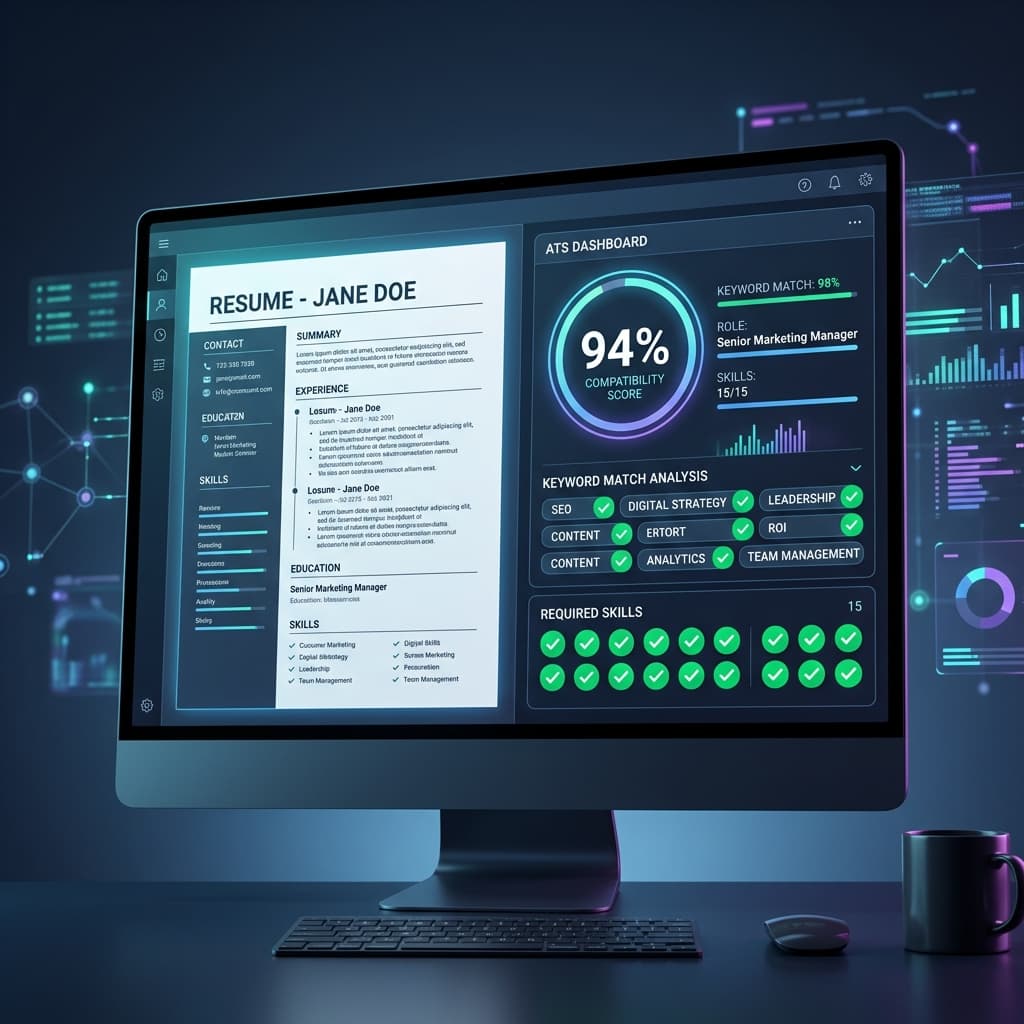
Right now, your resume is being judged — not by a human, but by software. Here is everything you need to know about the Applicant Tracking System and exactly how to beat it.
What Is an Applicant Tracking System?
An Applicant Tracking System (ATS) is software that companies use to collect, sort, and filter job applications before a human recruiter ever sees them. According to LinkedIn research, over 99% of Fortune 500 companies and more than 75% of mid-sized businesses now rely on an ATS as their first filter. This means the moment you click "Apply," a machine — not a person — decides whether your resume deserves a second look.
The ATS scans your document for specific keywords, proper section headings, and readable formatting. If your resume does not match the system's criteria, it is automatically rejected — regardless of how qualified you actually are. Studies suggest that up to 75% of resumes are discarded by ATS before being seen by human eyes. That is a staggering number, and it explains why so many exceptional candidates hear nothing but silence after submitting applications.
The good news? Once you understand how the system works, it becomes entirely beatable. You do not need to game the algorithm unfairly — you simply need to present your legitimate experience in the language and format that ATS software can read, understand, and score favorably.
Why Most Candidates Fail the ATS Screen
The most common reason resumes fail ATS screening has nothing to do with the candidate's qualifications. It is almost always a formatting or keyword mismatch. Here are the top reasons applications are automatically filtered out:
- Multi-column layouts: ATS parsers read text left-to-right in a linear sequence. A two-column layout causes your job title from column one to be combined with your education header from column two, producing unreadable garbage in the database.
- Tables and text boxes: Content inside tables or floating text boxes is often completely skipped by the parser, meaning your skills or experience may be invisible to the system.
- Missing keywords: If the job description says "cross-functional collaboration" and your resume says "inter-departmental teamwork," many ATS systems will score you zero for that requirement even though they mean the same thing.
- Non-standard section headers: Calling your work history "Where I've Been" instead of "Work Experience" breaks the ATS's categorization logic.
- Graphics and icons: Skill bars, social media icons, and logos cannot be read by parsers. They either get ignored or converted to corrupted characters that break the surrounding text.
The Step-by-Step Strategy to Beat Any Applicant Tracking System
Step 1: Use a Single-Column, ATS-Safe Format
Your first priority is ensuring the ATS can parse your document cleanly. Choose a single-column layout with clear white space. Use standard fonts like Arial, Calibri, or Georgia at a size between 10pt and 12pt. Keep your contact information in the body of the document — never in the header or footer — as many parsers skip those areas entirely.
Step 2: Mirror the Job Description's Language
Read the target job description carefully and identify the high-frequency keywords — typically job titles, tool names, methodologies, certifications, and required skills. Integrate these exact phrases into your Professional Summary, Work Experience bullets, and Skills section. Do not paraphrase. If the description says "Agile project management," write "Agile project management" — not "iterative development approach."
Step 3: Use Standard Section Headers
Stick to universally recognized section titles: Work Experience, Education, Skills, Certifications, and Professional Summary. These are the labels ATS systems are programmed to recognize. Creative alternatives, however clever, will break the parser.
Step 4: Write Achievement Bullets with Metrics
Beyond parsing, once your resume reaches a human recruiter, your bullets must impress them too. Use the formula: Action Verb + Task + Quantified Result. For example: "Reduced customer onboarding time by 40% by redesigning the automated email sequence, resulting in a 22% increase in 30-day retention." This structure naturally integrates relevant keywords while also telling a compelling story of impact.
Step 5: Check Your Score Before Submitting
Never submit a resume without testing it first. An ATS resume checker gives you an exact match score, flags missing keywords, and identifies formatting errors invisible to the naked eye. Think of it as a flight simulator — you test the conditions before the real flight. This single habit can be the difference between a 45% match score and a 90% match score.
Is Your Resume Beating the Applicant Tracking System Right Now?
Upload your resume and paste any job description. Our AI will instantly reveal your ATS match score, flag every keyword gap, and auto-rewrite your resume to beat the system — no manual editing needed.
Upload Resume
PDF, DOCX, or TXT
Tap to upload or drop file
PDF, DOCX, or TXT
Don't have a resume?
Build a professional ATS-friendly resume from scratch in minutes.
Target
Select a Job Role to check your ATS score against that profession and have our AI optimize your resume for it. Switch to Job Description for a precise analysis.
Understanding ATS Scoring: How Your Rank Is Calculated
Most modern ATS platforms rank candidates using a combination of keyword frequency, semantic relevance, experience duration, and education match. When a recruiter opens their dashboard, they do not see a chronological list of applicants. They see a ranked leaderboard sorted by ATS match score. Candidates in the top 10-20% of scores are reviewed by human recruiters. Everyone else is automatically archived.
| ATS Score Range | Recruiter Action | Your Outcome |
|---|---|---|
| 85%–100% | Reviewed within hours. Often fast-tracked. | Interview invitation likely |
| 70%–84% | Reviewed if top tier is small. May be shortlisted. | Possible callback |
| Below 70% | Rarely reviewed. Filtered to archive. | Automated rejection |
Industry-Specific Tips for Beating ATS in the US and UK Job Markets
The US and UK job markets both heavily rely on ATS, but with some nuances. In the United States, ATS systems used by companies like Google, Amazon, and Fortune 500 firms (including Workday, Greenhouse, and Taleo) heavily weight exact keyword matches and quantified achievements. Certifications such as PMP, AWS, CPA, and SHRM-CP carry significant weight.
In the United Kingdom, ATS systems are similar but the language nuances differ. "CV" is more commonly used than "resume," but the underlying ATS algorithms work identically. UK employers frequently use systems like Applicant Pro and Sage HR. Key differences include: UK CVs often include a brief personal statement rather than a professional summary, and the date format convention differs (DD/MM/YYYY vs. MM/DD/YYYY in the US) — though this rarely affects parsing.
Regardless of geography, the core rules for beating an applicant tracking system remain constant: clean formatting, keyword alignment, quantified achievements, and pre-submission score verification.
The Shortcut: Let AI Do the Work
Manually tailoring a resume for every job application is time-consuming and error-prone. Modern AI-powered tools can analyze a job description, compare it to your resume, calculate an exact ATS match score, and automatically rewrite your resume to maximize your ranking — all in under 60 seconds.
ATS Resume Flow is built specifically for this workflow. Upload your resume once, paste in the job description, and let the AI identify every gap and produce a fully optimized, ATS-compliant document tailored for that specific role. No guesswork, no manual keyword hunting, no wasted applications.